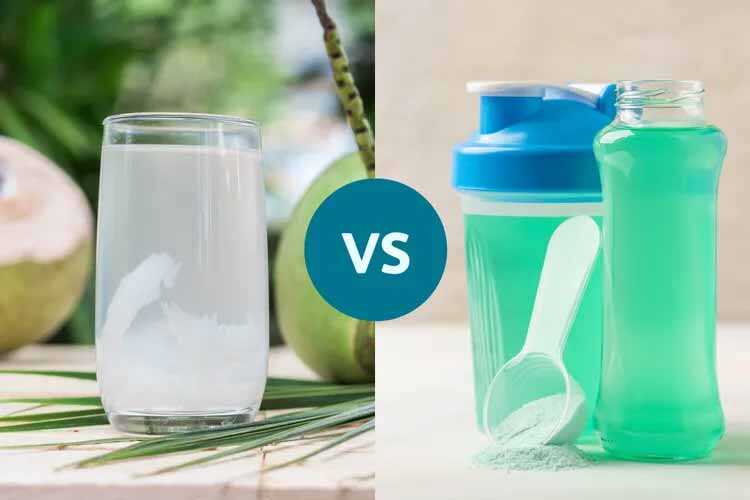
Coconut water and electrolyte drinks can help you stay hydrated and replenish fluids after exercise. While electrolyte drinks and powders are considered the best choice for intense exercise, they typically contain added sugar and other ingredients not found in coconut water.
Coconut Water vs. Electrolyte Drinks
Coconut water and electrolyte drinks (sports drinks) contain water and nutrients essential for hydration and electrolyte balance.
|
Nutrition Comparison: Coconut Water vs. Sports Drink |
||
| Coconut Water (1 c)1 | Gatorade (1 c)2 | |
| Calories | 44 | 65 |
| Carbohydrate | 10 g | 16 g |
| Total Sugars | 4 g | 13 g |
| Sodium | 64 mg | 97 mg |
| Iron | 0.07 mg | 0.12 mg |
| Calcium | 17 mg | 2.5 mg |
| Magnesium | 14 mg | 0 mg |
| Phosphorus | 12 mg | 25 mg |
| Potassium | 404 mg | 37 mg |
| Zinc | 0.05 mg | 0.03 mg |
| Copper | 0.02 mg | 0.02 mg |
| Vitamin C | 24 mg | 1 mg |
Abbreviations: cup (c), gram (g), milligram (mg)
Both beverages contain carbohydrates and essential minerals that are important to hydration.
- Minerals like sodium, calcium, phosphorus, magnesium, and potassium help maintain fluid balance in your body. Carbohydrates help your body absorb these minerals.34
- When compared, coconut water contains more calcium, magnesium, and potassium.
- Gatorade contains more sodium, phosphorus, carbohydrates, and sugar.
What Are Electrolytes?
Electrolytes are essential minerals your body needs for specific functions, including hydration.
- Electrolytes dissolve in fluids in your body and have either a positive or negative charge.3
- Electrolyte needs may vary based on age and other factors, such as a health condition.
- Adults need specific amounts of electrolytes to maintain health and hydration.
|
Daily Electrolyte Recommendations for Adults |
||
| Males | Females | |
| Calcium5 | 1,000 mg | 1,000 mg |
| Magnesium6 | 400-420 mg | 310-320 mg |
| Phosphorus7 | 700 mg | 700 mg |
| Potassium8 | 3,400 mg | 2,600 mg |
| Sodium9 | <2,300 mg | <2,300 mg |
- You can get all the necessary electrolytes through a regular diet.
- However, electrolyte supplements and beverages may be necessary if you have an electrolyte imbalance, which heavy sweating, an illness, or a health condition may cause.3
Coconut Water
Coconut water comes from young coconuts and is different from coconut milk. It has been used for centuries to treat dehydration, stomach infections, and other conditions.10
- Some research shows that coconut water may improve hydration in athletes. According to one study, coconut water was as effective as a sports drink in maintaining hydration, heart rate, and performance during prolonged cycling.11 However, the study was small.
- Coconut water is lower in sugar than many electrolyte drinks and powders. One study on rats with diabetes showed that it may also help reduce blood sugar.12 However, whether this may apply to humans is unclear.
- Coconut water may not be right for some people. People with kidney issues may need to limit coconut water, as their kidneys may not be able to filter potassium properly, leading to high blood potassium levels (hyperkalemia).13
- Some people may be allergic to coconut water. Although a coconut allergy is rare, you may experience anaphylaxis or other adverse reactions if you have a coconut allergy and drink coconut water.14
Electrolyte Powders
Electrolyte powders tend to enhance hydration, but using them may have drawbacks.
- Electrolyte powders contain essential nutrients for hydration. Electrolyte powders typically have high concentrations of carbohydrates and essential minerals needed to maintain fluid balance and prevent dehydration.3
- Some products contain added sugar and synthetic ingredients. Although generally considered safe, many electrolyte powders contain added sugar and artificial ingredients to enhance flavor.
- Electrolyte powders are somewhat inconvenient. Unlike other rehydration beverages, they must be mixed with water, which may be difficult on the go or in specific settings.
Sports Drinks
Sports drinks are similar to electrolyte powders, but are ready-made and may contain different concentrations of carbohydrates and electrolytes.
- Sports drinks are high in carbohydrates and may replenish fluids quickly. Research shows that sports drinks stimulate fluid reabsorption and retention compared to water alone.15
- Sports drinks may enhance athletic performance. Research shows that using sports drinks during exercise or training may increase energy and boost performance.16
- Sports drinks have more added sugar and calories than other hydration beverages. Excessive consumption of sports drinks has been associated with weight gain.15
How Often Should You Drink Electrolytes?
For most people, water is adequate for maintaining daily hydration.
Typically, electrolyte drinks are only necessary when you have an electrolyte imbalance. Common causes of electrolyte imbalance include:3
- Heavy sweating from intense exercise
- Diarrhea or vomiting
- Heart, liver, or kidney problems
- Specific medications
You may have an electrolyte imbalance if you experience any signs of dehydration, like:17
- Feeling thirsty
- Dry mouth
- Infrequent urination
- Dark yellow urine
- Headache
- Muscle cramps
Contact a healthcare provider to find the best treatment option if you’re concerned about an electrolyte imbalance.
How to Choose the Healthiest, Most Hydrating Beverage
Choosing the healthiest option may feel confusing regarding coconut water vs. electrolyte drinks.
Here are some tips that may make choosing the best hydrating beverage easier:
- Coconut water is lower in sugar and sodium than electrolyte powders and sports drinks.12
- Sports drinks are recommended for intense or prolonged exercise due to their higher concentrations of carbohydrates, sodium, and other minerals.15
- Coconut water is high in potassium and may not be recommended for people with kidney issues.13
- Electrolyte powders and sports drinks may offer quicker hydration compared to coconut water.15
- Sports drinks are higher in calories and may lead to weight gain if consumed excessively.15
Some trial and error may be necessary before you find the hydrating beverage that best suits your needs.
For further guidance, be sure to contact your healthcare provider or registered dietitian nutritionist (RD/RDN).
Key Takeaways
- Coconut water, electrolyte drinks, and electrolyte powders contain carbohydrates and minerals that aid hydration.
- Coconut water is a natural hydration beverage, lower in sugar than sports drinks and electrolyte powders.
- Electrolyte drinks and powders are typically recommended for strenuous exercise and may replenish fluids faster.
Sources:
- USDA FoodData central. Beverages, coconut water, ready-to-drink, unsweetened.
- USDA FoodData Central. Sports drink (Gatorade G).
- Fluid and electrolyte balance.
- Berry CW, Wolf ST, Cottle RM, Kenney WL. Hydration is more important than exogenous carbohydrate intake during push-to-the-finish cycle exercise in the heat. Front Sports Act Living. 2021;3:742710. doi:10.3389/fspor.2021.742710
- National Institutes of Health. Calcium: Fact sheet for health professionals.
- National Institutes of Health. Magnesium: Fact sheet for health professionals.
- National Institutes of Health. Phosphorus: Fact sheet for health professionals.
- National Institutes of Health. Potassium: Fact sheet for health professionals.
- Sodium.
- Segura-Badilla O, Lazcano-Hernández M, Kammar-García A, et al. Use of coconut water (Cocus nucifera L) for the development of a symbiotic functional drink. Heliyon. 2020;6(3):e03653. doi:10.1016/j.heliyon.2020.e03653
- O’Brien BJ, Bell LR, Hennessy D, et al. Coconut water: A sports drink alternative?. Sports (Basel). 2023;11(9):183. doi:10.3390/sports11090183
- Dai Y, Peng L, Zhang X, et al. Effects of coconut water on blood sugar and retina of rats with diabetes. PeerJ. 2021;9:e10667. doi:10.7717/peerj.10667
- Wieërs MLAJ, Mulder J, Rotmans JI, Hoorn EJ. Potassium and the kidney: a reciprocal relationship with clinical relevance. Pediatr Nephrol. 2022;37(10):2245-2254. doi:10.1007/s00467-022-05494-5
- Kruse L, Lor J, Yousif R, Pongracic JA, Fishbein AB. Coconut allergy: Characteristics of reactions and diagnostic predictors in a pediatric tertiary care center. Ann Allergy Asthma Immunol. 2021;126(5):562-568.e1. doi:10.1016/j.anai.2021.01.027
- Muñoz-Urtubia N, Vega-Muñoz A, Estrada-Muñoz C, Salazar-Sepúlveda G, Contreras-Barraza N, Castillo D. Healthy behavior and sports drinks: A systematic review. Nutrients. 2023;15(13):2915. doi:10.3390/nu15132915
- Orrù S, Imperlini E, Nigro E, et al. Role of functional beverages on sport performance and recovery. Nutrients. 2018;10(10):1470. doi:10.3390/nu10101470
- Dehydration.
Important Notice: This article was originally published at www.verywellhealth.com by Brittany Lubeck, MS, RDN, where all credits are due.
Disclaimer
The watching, interacting, and participation of any kind with anything on this page does not constitute or initiate a doctor-patient relationship with Dr. Farrah™. None of the statements here have been evaluated by the Food and Drug Administration (FDA). The products of Dr. Farrah™ are not intended to diagnose, treat, cure, or prevent any disease. The information being provided should only be considered for education and entertainment purposes only. If you feel that anything you see or hear may be of value to you on this page or on any other medium of any kind associated with, showing, or quoting anything relating to Dr. Farrah™ in any way at any time, you are encouraged to and agree to consult with a licensed healthcare professional in your area to discuss it. If you feel that you’re having a healthcare emergency, seek medical attention immediately. The views expressed here are simply either the views and opinions of Dr. Farrah™ or others appearing and are protected under the first amendment.
Dr. Farrah™ is a highly experienced Licensed Medical Doctor certified in evidence-based clinical nutrition, not some enthusiast, formulator, or medium promoting the wild and unrestrained use of nutrition products for health issues without clinical experience and scientific evidence of therapeutic benefit. Dr. Farrah™ has personally and keenly studied everything she recommends, and more importantly, she’s closely observed the reactions and results in a clinical setting countless times over the course of her career involving the treatment of over 150,000 patients.
Dr. Farrah™ promotes evidence-based natural approaches to health, which means integrating her individual scientific and clinical expertise with the best available external clinical evidence from systematic research. By individual clinical expertise, I refer to the proficiency and judgment that individual clinicians acquire through clinical experience and clinical practice.
Dr. Farrah™ does not make any representation or warranties with respect to the accuracy, applicability, fitness, or completeness of any multimedia content provided. Dr. Farrah™ does not warrant the performance, effectiveness, or applicability of any sites listed, linked, or referenced to, in, or by any multimedia content.
To be clear, the multimedia content is not intended to be a substitute for professional medical advice, diagnosis, or treatment. Always seek the advice of your physician or other qualified health providers with any questions you may have regarding a medical condition. Never disregard professional medical advice or delay in seeking it because of something you have read or seen in any website, video, image, or media of any kind. Dr. Farrah™ hereby disclaims any and all liability to any party for any direct, indirect, implied, punitive, special, incidental, or other consequential damages arising directly or indirectly from any use of the content, which is provided as is, and without warranties.