
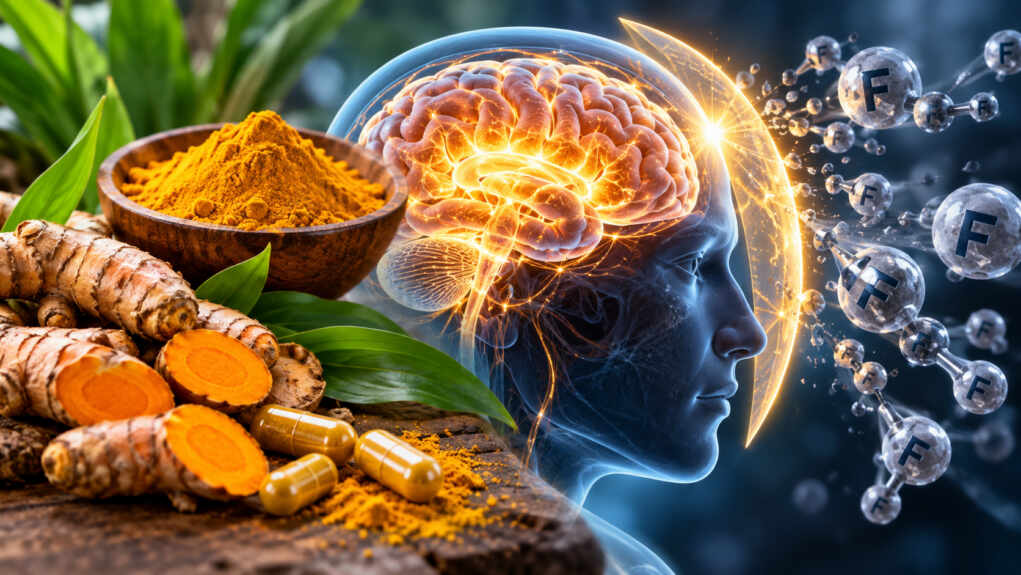
Turmeric has long been valued for its vivid golden color and distinctive flavor, but modern research has made its most famous compound, curcumin, the subject of intense scientific interest. The spice has been investigated for its antioxidant and anti-inflammatory properties, including possible effects on the brain. Yet one particularly intriguing line of research goes further: laboratory studies suggest that curcumin may help protect brain tissue against damage associated with excessive fluoride exposure. That finding is interesting—but it is also easy to overstate. The research so far does not establish that eating turmeric prevents fluoride-related brain effects in humans.
What makes the finding worth examining is the larger question it raises about turmeric itself. Curcumin is only one of the many biologically active compounds found in the plant, and research increasingly suggests that turmeric’s potential effects cannot necessarily be reduced to a single ingredient. At the same time, evidence from human trials remains much less definitive than the headlines surrounding turmeric often suggest. The more useful lesson may therefore be not that turmeric is a miracle “brain protector,” but that this familiar culinary spice contains compounds worthy of continued scientific investigation.
What the Fluoride Research Actually Found
The specific fluoride connection comes from experimental research rather than a large human clinical trial.
In a study published in Pharmacognosy Magazine, researchers exposed young mice to a high concentration of fluoride and examined changes in their brains. The animals exposed to fluoride showed increased lipid peroxidation—a marker associated with oxidative stress—as well as degenerative changes in areas of the hippocampus, a brain region involved in learning and memory.
The researchers then gave another group of animals curcumin along with fluoride. Compared with the animals receiving fluoride alone, the curcumin-treated group showed less lipid peroxidation and fewer signs of neuronal degeneration. The investigators concluded that curcumin appeared to reduce some of the neurological damage produced by the experimental fluoride exposure.
A separate study involving rats exposed to sodium fluoride during the prenatal and early postnatal periods reported similar findings. Curcumin treatment was associated with improvements in several behavioral, biochemical and hippocampal measures compared with fluoride exposure alone.
These results are scientifically interesting, but there is an important qualification: mice and rats are not humans. The fluoride doses and methods of exposure used in animal experiments can also differ substantially from everyday human exposure. Consequently, these studies cannot establish that consuming turmeric will protect a person from fluoride.
Why Fluoride and the Brain Are Being Studied
The question of fluoride and brain development has attracted considerable scientific attention, particularly concerning higher levels of exposure during childhood.
A 2024 systematic review from the U.S. National Toxicology Program found moderate confidence in an association between higher estimated fluoride exposure and lower IQ in children. The review emphasized, however, that much of the evidence involved exposure levels above those typically associated with optimally fluoridated U.S. drinking water. It also found insufficient evidence to determine whether the U.S. recommended level of 0.7 milligrams per liter negatively affects children’s IQ.
That distinction matters. Fluoride exposure is not an all-or-nothing issue, and the available research does not justify treating every level of fluoride exposure as equivalent. Cleveland Clinic similarly notes that concerns about effects on brain development have largely arisen from studies involving regions with naturally high fluoride concentrations, while U.S. community water systems use a substantially lower target concentration.
In other words, research into excessive fluoride exposure does not automatically mean that ordinary fluoride exposure is harmful, nor does it mean that turmeric is needed to counteract it.
Where Turmeric Enters the Picture
Curcumin is the bright-yellow compound that gives turmeric much of its characteristic color. It has antioxidant and anti-inflammatory properties and has been investigated for a wide range of potential health effects.
This is one reason the fluoride experiments are biologically plausible. If excessive fluoride exposure contributes to oxidative stress and cellular damage under experimental conditions, a compound with antioxidant activity could theoretically influence some of those pathways.
But “theoretically possible” is not the same as “clinically proven.”
The National Center for Complementary and Integrative Health says that laboratory research has identified potentially relevant antioxidant and anti-inflammatory effects of curcumin, but clinical research on its effects on cognitive decline and Alzheimer’s disease remains limited and inconsistent.
Mayo Clinic likewise reports that curcumin has antioxidant and anti-inflammatory properties, but clinical trials have not demonstrated a benefit for treating Alzheimer’s disease.
That gap between laboratory findings and human outcomes is one of the most important facts to remember when evaluating turmeric claims.
The Bigger Truth About Turmeric
Perhaps the most interesting lesson from the fluoride research is that turmeric should not necessarily be viewed as a one-compound plant.
Curcumin receives most of the scientific attention, but turmeric contains numerous other compounds. Mayo Clinic notes that substances beyond curcumin—including several noncurcumin constituents—have demonstrated biological activity in experimental research.
This raises a broader question: could the health effects of a whole food or spice differ from those of an isolated compound?
Scientists do not yet have a definitive answer. Turmeric supplements can vary considerably in their curcumin content and formulation. Some products also contain piperine, a compound from black pepper that can increase curcumin absorption. The National Center for Complementary and Integrative Health points out that different formulations can therefore produce very different exposures in the body.
This is one reason results from a study using purified curcumin cannot automatically be translated into the effects of sprinkling turmeric into food.
Turmeric’s Brain Story Is Promising—but Unfinished
There are reasons researchers continue to investigate turmeric and brain health.
Cleveland Clinic describes preliminary evidence suggesting that curcumin may have effects on memory and cognition, including findings from an 18-month study in which a particular curcumin preparation was associated with improved memory performance in older adults without dementia. The same source emphasizes that more research is needed, particularly regarding Alzheimer’s disease.
WebMD likewise reports that early research has linked curcumin with possible effects on memory and brain health, while cautioning that much of the research remains preliminary and that clinical evidence has not yet established broad health benefits.
Harvard Health takes a more skeptical view of the supplement market as a whole, noting that there is not solid evidence that over-the-counter brain-health supplements can improve thinking or prevent memory loss.
Taken together, these sources point toward a reasonable middle ground: turmeric and curcumin are scientifically interesting, but they should not be presented as established treatments or shields against neurological disease.
Food First, Miracle Claims Last
There is also an important practical distinction between using turmeric as a food and taking concentrated curcumin supplements.
Adding turmeric to meals is a traditional culinary practice and provides a relatively modest amount of its various plant compounds. Supplements, by contrast, can deliver much higher and more concentrated amounts.
The National Center for Complementary and Integrative Health notes that conventional oral turmeric is generally considered safe in recommended amounts for short periods, but side effects can include nausea, digestive problems and other gastrointestinal symptoms. Some highly bioavailable curcumin formulations have also been associated with liver injury.
Mayo Clinic similarly warns that turmeric and curcumin supplements can interact with medications, including drugs affecting blood clotting.
That makes the simple culinary use of turmeric a very different proposition from treating a supplement as a medical intervention.
What We Can—and Cannot—Say
The fluoride research offers a fascinating piece of the turmeric puzzle. In experimental animals, curcumin reduced several measures of fluoride-associated oxidative stress and neurological damage. More recent laboratory research has continued to investigate how curcumin might influence molecular pathways involved in fluoride-related neuroinflammation and mitochondrial dysfunction.
But there is currently no good evidence that eating turmeric prevents fluoride-related brain damage in humans.
What the research does show is something more subtle and potentially more valuable: turmeric contains biologically active compounds that can interact with pathways involved in inflammation, oxidative stress and cellular signaling. Those properties make the plant worthy of continued research, without requiring us to turn preliminary findings into a miracle-health claim.
The bigger truth about turmeric may therefore be less dramatic than a promise of protection—but more scientifically meaningful. A familiar kitchen spice can contain complex chemistry capable of producing measurable biological effects. The challenge for researchers is determining which effects matter in humans, at what doses, in which formulations, and under what circumstances.
For now, turmeric can reasonably remain what it has been for centuries: an flavorful culinary ingredient with an intriguing scientific story. The evidence may eventually tell us that some of its compounds have useful therapeutic applications. But that answer will come from well-designed human research—not from the promise of a single spoonful of golden powder.
Sources:
- National Center for Complementary and Integrative Health — Turmeric
- Harvard Health — Brain-health supplements
- Cleveland Clinic — Turmeric health benefits and side effects
- Mayo Clinic — Turmeric and health research
- WebMD — Turmeric and curcumin information
Website operated and published by:
FAB LTD
Ground Floor, 14 Stewart Dr.
Berea, East London 5241
South Africa
Disclaimer
The watching, interacting, and participation of any kind with anything on this page does not constitute or initiate a doctor-patient relationship with Dr. Farrah™. None of the statements here have been evaluated by the Food and Drug Administration (FDA). The products of Dr. Farrah™ are not intended to diagnose, treat, cure, or prevent any disease. The information being provided should only be considered for education and entertainment purposes only. If you feel that anything you see or hear may be of value to you on this page or on any other medium of any kind associated with, showing, or quoting anything relating to Dr. Farrah™ in any way at any time, you are encouraged to and agree to consult with a licensed healthcare professional in your area to discuss it. If you feel that you’re having a healthcare emergency, seek medical attention immediately. The views expressed here are simply either the views and opinions of Dr. Farrah™ or others appearing and are protected under the First Amendment.
Dr. Farrah™ is a highly experienced Licensed Medical Doctor certified in evidence-based clinical nutrition, not some enthusiast, formulator, or medium promoting the wild and unrestrained use of nutrition products for health issues without clinical experience and scientific evidence of therapeutic benefit. Dr. Farrah™ has personally and keenly studied everything she recommends, and more importantly, she’s closely observed the reactions and results in a clinical setting countless times over the course of her career involving the treatment of over 150,000 patients.
Dr. Farrah™ promotes evidence-based natural approaches to health, which means integrating her individual scientific and clinical expertise with the best available external clinical evidence from systematic research. By individual clinical expertise, I refer to the proficiency and judgment that individual clinicians acquire through clinical experience and clinical practice.
Dr. Farrah™ does not make any representations or warranties with respect to the accuracy, applicability, fitness, or completeness of any multimedia content provided. Dr. Farrah™ does not warrant the performance, effectiveness, or applicability of any sites listed, linked, or referenced to, in, or by any multimedia content.
To be clear, the multimedia content is not intended to be a substitute for professional medical advice, diagnosis, or treatment. Always seek the advice of your physician or other qualified health providers with any questions you may have regarding a medical condition. Never disregard professional medical advice or delay in seeking it because of something you have read or seen in any website, video, image, or media of any kind. Dr. Farrah™ hereby disclaims any and all liability to any party for any direct, indirect, implied, punitive, special, incidental, or other consequential damages arising directly or indirectly from any use of the content, which is provided as is, and without warranties.