
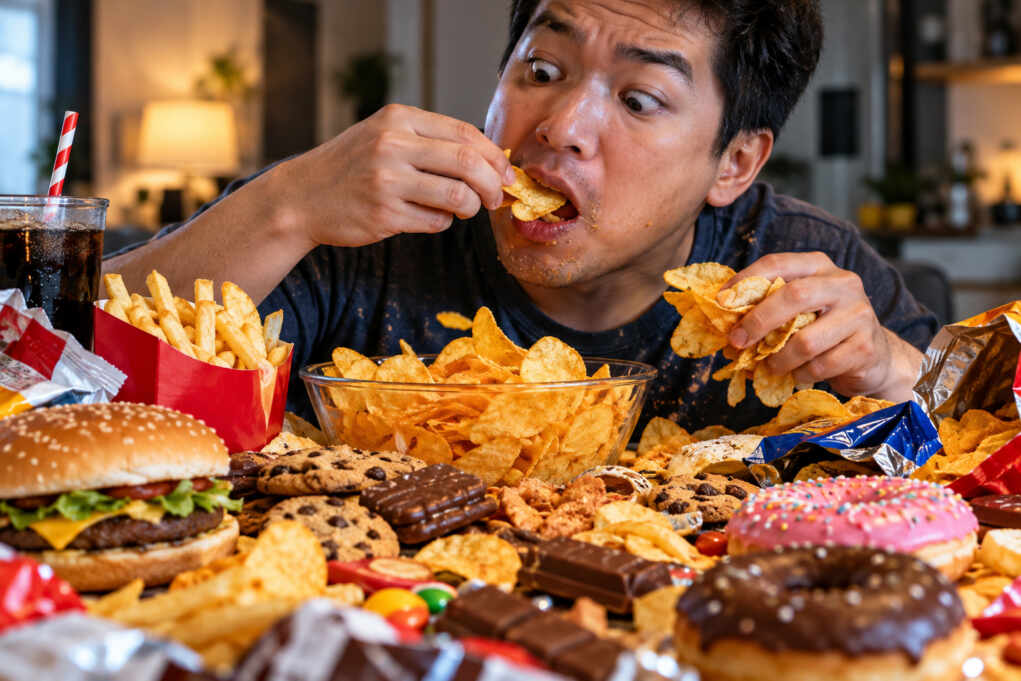
There is a reason it can be so difficult to stop after one chip, one cookie, or one handful of cheese-flavored snacks. Ultra-processed foods are not simply convenient foods that have been altered for longer shelf life; many are carefully formulated to deliver an appealing combination of sweetness, saltiness, fat, texture, and flavor. Increasing research suggests that, for some people, these foods can produce powerful cravings and patterns of consumption that resemble addictive behavior. A 2024 review of the emerging research estimated that about 14% of adults and 15% of children and adolescents globally may experience signs of addiction to ultra-processed foods.
At the same time, the science deserves some important qualifications. Food addiction is not currently recognized as an official medical diagnosis, and scientists continue to debate whether certain foods themselves can be considered addictive in the same way as substances such as nicotine or alcohol. The evidence for ultraprocessed-food addiction remains limited, while some health experts describe addictive-like eating as a genuine experience for many people but emphasize that the question of whether food itself is addictive remains controversial. The strongest conclusion at this point may be that some ultraprocessed foods can promote powerful, repetitive eating behaviors—and that the phenomenon deserves serious scientific attention.
What Makes A Food “Ultraprocessed”?
Not everything that comes in a package is ultraprocessed. Processing can be as simple as washing, freezing, chopping or pasteurizing food. Ultraprocessed foods generally go much further, using industrial formulations and ingredients or additives that are uncommon in ordinary home cooking.
Examples can include packaged chips, sugary drinks, candy, sweetened breakfast cereals, many frozen meals, instant noodles, packaged baked goods and some processed meat products. They often contain combinations of refined carbohydrates, added sugars, fats, and sodium, while providing relatively little fiber.
There is also an important distinction: ultra-processed does not automatically mean unhealthy. Some whole-grain breads, yogurts, and other packaged foods can provide meaningful nutrition. Food processing exists on a spectrum, and nutritional quality matters alongside the degree of processing.
Why Is It So Hard To Stop?
One possible explanation is the way certain ultra-processed foods combine nutrients and sensory characteristics. Foods containing substantial amounts of refined carbohydrates and fat can be particularly rewarding, while intense flavors, textures, and aromas can encourage people to continue eating.
These foods may also be easy to consume quickly. They are frequently soft, crunchy or highly palatable, require little preparation and are readily available. The result can be a combination of strong reward signals, convenience, and relatively weak satiety—the feeling of being comfortably full.
Research has even demonstrated that ultraprocessing can affect how much people eat. In a small randomized controlled trial, participants consumed more calories and gained more weight while eating an ultraprocessed diet than while eating an unprocessed diet, despite the diets being matched for several nutritional characteristics.
The Brain’s Reward System May Be Part Of The Story
Eating is supposed to be rewarding. The brain encourages us to seek out food because food is essential for survival. But researchers are investigating whether highly palatable ultra-processed foods can excessively stimulate reward pathways in ways that encourage repeated consumption.
Dopamine is one chemical involved in the brain’s reward and motivation systems. It is sometimes described as the “pleasure chemical,” but its role is more complicated: it helps reinforce behaviors and motivates us to seek rewards. Researchers are investigating whether certain combinations of saturated fat, added sugars and sodium can mimic some characteristics associated with addictive substances.
That does not mean eating a cookie is equivalent to taking an addictive drug. The comparison is an area of scientific investigation, not a settled fact.
Signs Of Addiction-Like Eating
Researchers studying food addiction look for behaviors that go beyond simply enjoying favorite foods. These can include:
- Strong or persistent cravings.
- Eating more than intended.
- Repeated unsuccessful attempts to cut back.
- Continuing to eat despite knowing there may be negative consequences.
- Spending significant time thinking about or obtaining certain foods.
- Experiencing distress or disruption to everyday life because of eating behaviors.
A nationally representative survey of U.S. adults ages 50 to 80 found that about 13% of respondents reported symptoms consistent with addiction to highly processed foods. The survey used criteria involving symptoms such as intense cravings, difficulty reducing consumption, and withdrawal-like experiences.
Importantly, such survey findings should not be interpreted as proof that 13% of older adults have a formally recognized medical disorder. They indicate that a substantial number of people report addiction-like eating experiences.
The Health Problem Goes Beyond Cravings
Even if the scientific debate over “food addiction” continues, there is much stronger evidence that diets high in ultra-processed foods are associated with a range of adverse health outcomes.
Research consistently associates higher ultraprocessed-food consumption with poorer cardiometabolic health, including greater risks of cardiovascular disease, obesity and type 2 diabetes.
The issue may be partly nutritional. Many ultraprocessed foods are high in added sugars, sodium and saturated fat while being relatively low in fiber and other beneficial nutrients. But researchers are also investigating whether the physical structure of foods, additives, processing methods, and the speed at which foods are consumed contribute independently to health effects.
Is Ultraprocessed-Food Addiction Increasing?
The popularity and availability of ultraprocessed foods have made them an increasingly prominent part of modern diets. According to recent U.S. data, ultraprocessed foods account for a substantial share of calories consumed by both adults and children.
However, it is important not to overstate what the research proves. Scientists have reported substantial levels of addiction-like eating, and the research field itself is expanding, but there is not yet enough evidence to establish a worldwide year-by-year increase in ultraprocessed-food addiction specifically. What can be said more confidently is that exposure to ultra-processed foods is widespread, consumption is substantial, and scientific interest in their addictive potential is growing.
Breaking The “Just One More” Cycle
The answer isn’t necessarily to eliminate every packaged food from your kitchen. That approach can be unrealistic, and some processed foods can be nutritious and convenient.
Instead, health organizations generally emphasize building meals around minimally processed foods—such as vegetables, fruits, beans, whole grains, nuts, seeds, and sources of protein—and reducing reliance on ultra-processed products that are especially high in added sugars, sodium, and unhealthy fats.
Small environmental changes can help, too: keeping nutritious snacks readily available, eating regular balanced meals, checking ingredient and nutrition labels, and avoiding situations where highly tempting foods are constantly within reach. Replacing ultraprocessed snacks with less processed alternatives can also be more practical than relying entirely on willpower.
Ultimately, the “Betcha can’t eat just one” phenomenon may be more than a clever advertising slogan for some people. Science increasingly suggests that certain ultra-processed foods can interact with reward, appetite and eating behavior in ways that make moderation difficult. But calling this a true addiction remains a scientific question under investigation.
What is already clear is that the food environment has changed dramatically—and understanding why some foods are so difficult to resist could be an important step toward making healthier eating easier, rather than simply telling people to try harder.
Sources:
- American Heart Association — Are Ultraprocessed Foods Good or Bad?
- Yale School of Public Health — Ultra-Processed Foods Information Sheet
- Cleveland Clinic — Why Are Certain Foods So Addictive?
- Harvard Health — More Evidence That Ultra-Processed Foods Harm Health
- Mayo Clinic — What You Should Know About Processed, Ultra-Processed Foods
Website operated and published by:
FAB LTD
Ground Floor, 14 Stewart Dr.
Berea, East London 5241
South Africa
Disclaimer
The watching, interacting, and participation of any kind with anything on this page does not constitute or initiate a doctor-patient relationship with Dr. Farrah™. None of the statements here have been evaluated by the Food and Drug Administration (FDA). The products of Dr. Farrah™ are not intended to diagnose, treat, cure, or prevent any disease. The information being provided should only be considered for education and entertainment purposes only. If you feel that anything you see or hear may be of value to you on this page or on any other medium of any kind associated with, showing, or quoting anything relating to Dr. Farrah™ in any way at any time, you are encouraged to and agree to consult with a licensed healthcare professional in your area to discuss it. If you feel that you’re having a healthcare emergency, seek medical attention immediately. The views expressed here are simply either the views and opinions of Dr. Farrah™ or others appearing and are protected under the First Amendment.
Dr. Farrah™ is a highly experienced Licensed Medical Doctor certified in evidence-based clinical nutrition, not some enthusiast, formulator, or medium promoting the wild and unrestrained use of nutrition products for health issues without clinical experience and scientific evidence of therapeutic benefit. Dr. Farrah™ has personally and keenly studied everything she recommends, and more importantly, she’s closely observed the reactions and results in a clinical setting countless times over the course of her career involving the treatment of over 150,000 patients.
Dr. Farrah™ promotes evidence-based natural approaches to health, which means integrating her individual scientific and clinical expertise with the best available external clinical evidence from systematic research. By individual clinical expertise, I refer to the proficiency and judgment that individual clinicians acquire through clinical experience and clinical practice.
Dr. Farrah™ does not make any representations or warranties with respect to the accuracy, applicability, fitness, or completeness of any multimedia content provided. Dr. Farrah™ does not warrant the performance, effectiveness, or applicability of any sites listed, linked, or referenced to, in, or by any multimedia content.
To be clear, the multimedia content is not intended to be a substitute for professional medical advice, diagnosis, or treatment. Always seek the advice of your physician or other qualified health providers with any questions you may have regarding a medical condition. Never disregard professional medical advice or delay in seeking it because of something you have read or seen in any website, video, image, or media of any kind. Dr. Farrah™ hereby disclaims any and all liability to any party for any direct, indirect, implied, punitive, special, incidental, or other consequential damages arising directly or indirectly from any use of the content, which is provided as is, and without warranties.