
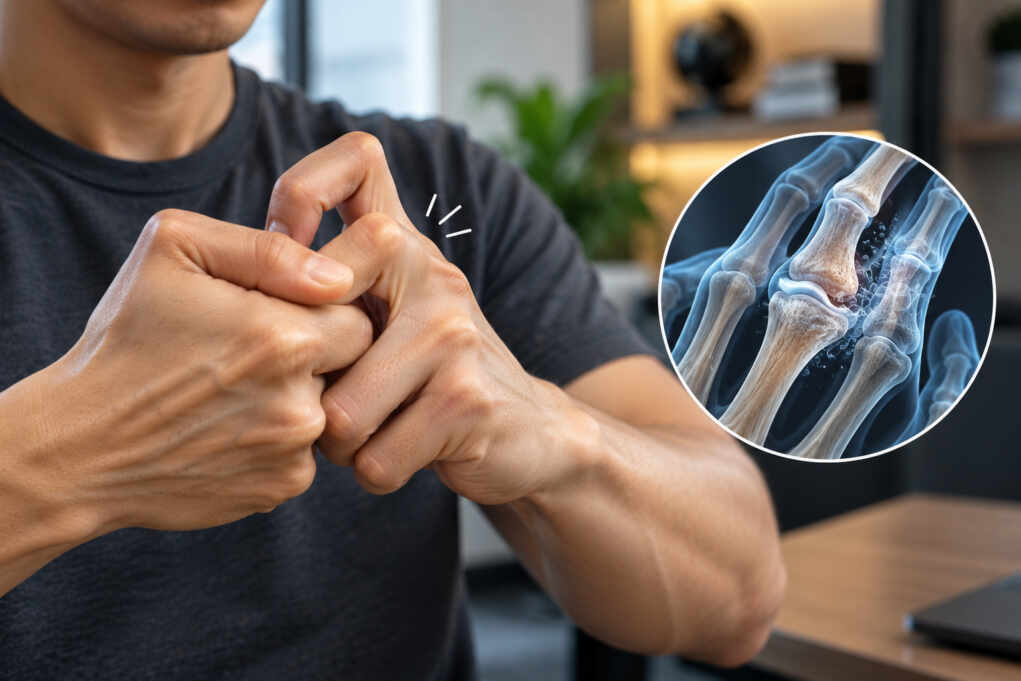
If you have a habit of cracking your knuckles, you have probably heard the familiar warning: “Stop doing that—you’ll get arthritis.” For generations, knuckle cracking has been blamed for damaging joints, making fingers larger, or causing arthritis later in life. But what does medical research actually say? According to health experts and available research, ordinary knuckle cracking does not appear to increase the risk of arthritis. The characteristic popping sound is also not caused by your bones “cracking” or breaking. Instead, it is associated with changes involving gas and pressure within the fluid-filled spaces of the joints.
That does not necessarily mean you should crack your knuckles as forcefully or as often as possible. While occasional, painless cracking is generally considered harmless, using excessive force can injure a ligament or even dislocate a joint. Pain, swelling, crooked fingers, or other unusual symptoms are signs that something may be wrong and should not simply be dismissed as part of the cracking habit.
Why Do Knuckles Make That Popping Sound?
Your finger joints contain synovial fluid, a slippery substance that helps reduce friction and allows the joints to move smoothly. When you stretch or pull a knuckle, pressure within the joint changes. This can produce a gas-filled cavity and the characteristic popping sound associated with knuckle cracking. Researchers have studied the exact mechanics of the sound for decades, and there has been some debate over whether the sound comes primarily from bubbles bursting or the rapid formation of a cavity in the joint fluid.
One reason you cannot immediately crack the same knuckle again is that the joint needs time before it can produce another similar pop. WebMD notes that this period can be around 20 minutes as the relevant gases and joint conditions return.
Does Cracking Your Knuckles Cause Arthritis?
This is probably the biggest concern surrounding the habit, but the evidence does not show that knuckle cracking causes arthritis.
Harvard Health reports that studies comparing habitual knuckle crackers with people who do not crack their knuckles have not found a reliable association between the habit and hand arthritis. Cleveland Clinic similarly reports that several studies have failed to establish a connection between knuckle cracking and arthritis.
Mayo Clinic also reports that studies have found comparable hand function, grip strength and range of motion between people who crack their knuckles and those who do not.
In other words, if you have been cracking your knuckles for years, there is no good evidence that the habit alone is destined to give you arthritis.
Can Knuckle Cracking Damage Your Hands?
Although arthritis does not appear to be a consequence of ordinary knuckle cracking, that does not mean there are absolutely no risks.
The main concern is how forcefully you crack your joints. Cleveland Clinic advises against excessive pressure or pulling the fingers in an unnatural direction because doing so can potentially injure a ligament or dislocate a knuckle. Knuckle cracking itself should not be painful.
Some older research also reported an association between habitual knuckle cracking, hand swelling and reduced grip strength. However, later research did not find the same effects, and Cleveland Clinic notes that more recent studies found no damaging effects on grip strength, swelling or range of motion.
This means the evidence about possible minor effects is less clear than the evidence regarding arthritis. There is considerably more reason to avoid forceful or painful cracking than to worry about an occasional painless pop.
When Should You Stop Cracking Your Knuckles?
If cracking your knuckles is painless and does not cause swelling or other symptoms, medical sources generally consider occasional cracking to be safe.
However, you should stop and consider speaking with a healthcare professional if you experience:
- Pain when the joint cracks or moves.
- Swelling around the finger or knuckle.
- A finger that looks crooked or deformed.
- Reduced movement or difficulty using the finger.
- A joint that feels unstable or locks.
- Symptoms that began after an injury.
Pain or swelling may indicate an underlying joint or soft-tissue problem rather than simply being the result of harmless joint noise. Harvard Health specifically recommends medical evaluation when cracking is accompanied by pain, swelling, numbness or other concerning symptoms.
What If You Want to Stop the Habit?
You do not need to stop cracking your knuckles simply because you are worried that it will cause arthritis. However, some people may want to break the habit because they find it distracting, annoying to others, or difficult to control.
Healthline recommends becoming more aware of when and why you crack your knuckles. If stress or nervousness triggers the habit, alternatives such as deep breathing, exercise or keeping your hands occupied with another object may help.
The key is to focus on the behavior rather than being frightened by an arthritis myth. If you crack your knuckles occasionally and comfortably, there is little evidence that you are damaging your joints. If you feel compelled to crack them repeatedly, try identifying what triggers the behavior and replace it with a less forceful activity.
The Bottom Line
So, should you crack your knuckles? The available evidence suggests that occasional, painless knuckle cracking is generally harmless and does not appear to cause arthritis. The sound comes from physical changes within the joint rather than your bones breaking or wearing away.
The bigger issue is excessive force. Never force a joint to crack if it hurts, and pay attention to swelling, deformity, reduced movement or other unusual symptoms. If those symptoms occur, getting the joint evaluated is more important than whether you can make it pop.
Ultimately, whether you continue a painless knuckle-cracking habit is largely a matter of personal preference. The science does not support the long-standing idea that every knuckle pop is damaging your joints.
Sources:
- Cleveland Clinic — “Should You Crack Your Knuckles?”
- Mayo Clinic — “Mayo Clinic Minute: A hand surgeon’s advice about knuckle cracking”
- Harvard Health — “Should I stop cracking my knuckles?”
- WebMD — “Is Cracking Your Knuckles Bad for You?”
- Healthline — “Is Cracking Your Knuckles Bad for You?”
Website operated and published by:
FAB LTD
Ground Floor, 14 Stewart Dr.
Berea, East London 5241
South Africa
Disclaimer
The watching, interacting, and participation of any kind with anything on this page does not constitute or initiate a doctor-patient relationship with Dr. Farrah™. None of the statements here have been evaluated by the Food and Drug Administration (FDA). The products of Dr. Farrah™ are not intended to diagnose, treat, cure, or prevent any disease. The information being provided should only be considered for education and entertainment purposes only. If you feel that anything you see or hear may be of value to you on this page or on any other medium of any kind associated with, showing, or quoting anything relating to Dr. Farrah™ in any way at any time, you are encouraged to and agree to consult with a licensed healthcare professional in your area to discuss it. If you feel that you’re having a healthcare emergency, seek medical attention immediately. The views expressed here are simply either the views and opinions of Dr. Farrah™ or others appearing and are protected under the First Amendment.
Dr. Farrah™ is a highly experienced Licensed Medical Doctor certified in evidence-based clinical nutrition, not some enthusiast, formulator, or medium promoting the wild and unrestrained use of nutrition products for health issues without clinical experience and scientific evidence of therapeutic benefit. Dr. Farrah™ has personally and keenly studied everything she recommends, and more importantly, she’s closely observed the reactions and results in a clinical setting countless times over the course of her career involving the treatment of over 150,000 patients.
Dr. Farrah™ promotes evidence-based natural approaches to health, which means integrating her individual scientific and clinical expertise with the best available external clinical evidence from systematic research. By individual clinical expertise, I refer to the proficiency and judgment that individual clinicians acquire through clinical experience and clinical practice.
Dr. Farrah™ does not make any representations or warranties with respect to the accuracy, applicability, fitness, or completeness of any multimedia content provided. Dr. Farrah™ does not warrant the performance, effectiveness, or applicability of any sites listed, linked, or referenced to, in, or by any multimedia content.
To be clear, the multimedia content is not intended to be a substitute for professional medical advice, diagnosis, or treatment. Always seek the advice of your physician or other qualified health providers with any questions you may have regarding a medical condition. Never disregard professional medical advice or delay in seeking it because of something you have read or seen in any website, video, image, or media of any kind. Dr. Farrah™ hereby disclaims any and all liability to any party for any direct, indirect, implied, punitive, special, incidental, or other consequential damages arising directly or indirectly from any use of the content, which is provided as is, and without warranties.