Key Takeaways
- Nuts contain high levels of nutrients that can help reduce the risk of cardiovascular diseases.
- There is typically no best time to eat nuts, but consuming them in the morning can help boost energy, while eating them at night may help improve sleep.
- Choosing the right nuts and the optimal time to eat them for your body will help you reap the benefits and enjoy the process.
Nuts are a great source of essential nutrients, and some research suggests that they can help reduce the risk of heart disease and inflammation and improve cholesterol levels. While some sources suggest eating nuts at a specific time, consuming them at any time of day can be beneficial.
When Should You Consume Nuts for Heart Health?
No clinical evidence supports the best time to eat nuts for heart health.
- Some evidence suggests that consuming them in the morning or mid-afternoon is better, as they also offer energy benefits.1
- However, evidence is lacking that eating them in the morning or afternoon is better for your heart.
- In some cases, eating tree nuts before bed may improve sleep because they contain high levels of tryptophan, a molecule that helps increase melatonin production, which aids in sleep.2
- If you incorporate nuts into your diet, do so at a time that works best for you.3
The Heart Health Benefits of Eating Nuts
Eating nuts has been shown to reduce the risk of developing various types of cardiovascular disease, including:4
- Coronary heart disease
- Stroke
- Heart failure
- Heart attack5
- Sudden cardiac death5
Research has also found that it can improve cholesterol and triglyceride levels, both of which are involved in the development of cardiovascular disease.
One study, in particular, examined the effects of pecans on cholesterol and found that participants’ bad (LDL) cholesterol and triglycerides decreased, along with an increase in good (HDL) cholesterol.6
Inflammation is the body’s response to injury or infection. When no injury or illness is present but inflammation persists, this can increase the risk of cardiovascular disease.
Nuts have been shown to reduce inflammation, which is another heart-healthy benefit.7
Heart-Healthy Nutrients in Nuts
Nuts contain high levels of various nutrients that play a role in heart health, including:5,8
- Healthy fats, such as omega-3
- Vitamin E
- Potassium
- Fiber
- Plant protein
- Folate
- Magnesium
- Phytochemicals
Adding Nuts to Your Diet
It’s easy to add nuts to your current diet. They can be eaten alone as a snack or added to your favourite meals for additional flavour.
- Nuts often pair well with vegetables when sautéed, chopped in salads, or cooked with squash or sweet potatoes.
- Since they work for savory and sweet foods, you can add nuts to sweeter foods, including yogurt.9
- It’s essential to note that, while nuts are healthy and rich in nutrients, overeating can be easy due to their high calorie content.5
- If you are worried about weight gain, adding nuts can still benefit your health, so long as you keep track of how many nuts you’re eating.
- If you’re worried about calories, you can also use nuts to replace other salty snacks that do not offer the same nutritional benefits.3
Choosing the Right Nuts
While all nuts offer benefits, opt for natural, roasted, or raw nuts, as they do not contain added salt or other ingredients. Some of the best nuts to add to your diet include:10
- Pecans
- Walnuts
- Almonds
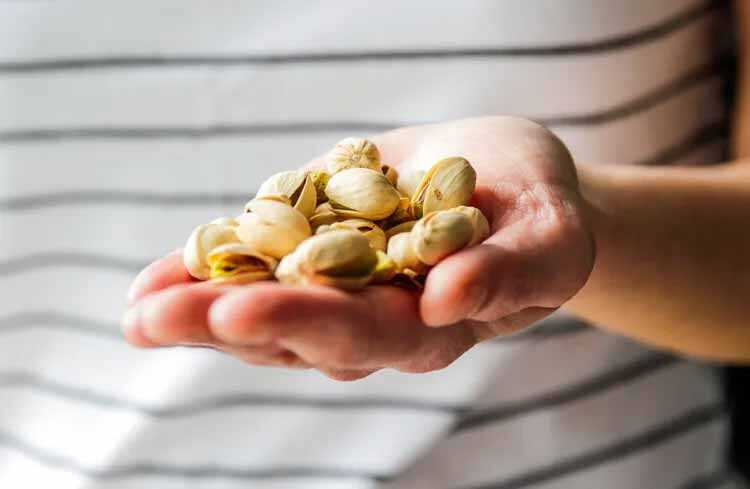
- Pistachios
- Peanuts
- Macadamia nuts
- Brazil nuts
- Cashews
Sources:
- Brown R, Ware L, Gray AR, et al. Snacking on almonds lowers glycaemia and energy intake compared to a popular high-carbohydrate snack food: An acute randomised crossover study. Int J Environ Res Public Health. 2021;18(20):10989. doi:10.3390/ijerph182010989.
- Zuraikat FM, Wood RA, Barragán R, St-Onge MP. Sleep and Diet: Mounting Evidence of a Cyclical Relationship. Annu Rev Nutr. 2021 Oct 11;41:309-332. doi:10.1146/annurev-nutr-120420-021719
- Harvard Health Publishing Harvard Medical School. How to eat nuts the healthy way.
- Balakrishna R, Bjørnerud T, Bemanian M, Aune D, Fadnes LT. Consumption of Nuts and Seeds and Health Outcomes Including Cardiovascular Disease, Diabetes and Metabolic Disease, Cancer, and Mortality: An Umbrella Review. Adv Nutr. 2022 Dec 22;13(6):2136-2148. doi:10.1093/advances/nmac077
- The Nutrition Source. Nuts for the Heart.
- Guarneiri LL, Paton CM, Cooper JA. Pecan-Enriched Diets Alter Cholesterol Profiles and Triglycerides in Adults at Risk for Cardiovascular Disease in a Randomized, Controlled Trial. J Nutr. 2021 Oct 1;151(10):3091-3101. doi:10.1093/jn/nxab248
- Cofán M, Rajaram S, Sala-Vila A, Valls-Pedret C, Serra-Mir M, Roth I, Freitas-Simoes TM, Bitok E, Sabaté J, Ros E. Effects of 2-Year Walnut-Supplemented Diet on Inflammatory Biomarkers. J Am Coll Cardiol. 2020 Nov 10;76(19):2282-2284. doi:10.1016/j.jacc.2020.07.071
- The National Heart Foundation of New Zealand. Nuts and seeds for heart health.
- Harvard Health Publishing Harvard Medical School. Nuts: All they’re cracked up to be?
- Olas B. The Cardioprotective Properties of Selected Nuts: Their Functional Ingredients and Molecular Mechanisms. Foods. 2024 Jan 11;13(2):242. doi:10.3390/foods13020242
Important Notice: This article was originally published at www.verywellhealth.com by Angelica Bottaro, where all credits are due. Medically reviewed by Aviv Joshua, MS, RDN
Disclaimer
The watching, interacting, and participation of any kind with anything on this page does not constitute or initiate a doctor-patient relationship with Dr. Farrah™. None of the statements here have been evaluated by the Food and Drug Administration (FDA). The products of Dr. Farrah™ are not intended to diagnose, treat, cure, or prevent any disease. The information being provided should only be considered for education and entertainment purposes only. If you feel that anything you see or hear may be of value to you on this page or on any other medium of any kind associated with, showing, or quoting anything relating to Dr. Farrah™ in any way at any time, you are encouraged to and agree to consult with a licensed healthcare professional in your area to discuss it. If you feel that you’re having a healthcare emergency, seek medical attention immediately. The views expressed here are simply either the views and opinions of Dr. Farrah™ or others appearing and are protected under the first amendment.
Dr. Farrah™ is a highly experienced Licensed Medical Doctor certified in evidence-based clinical nutrition, not some enthusiast, formulator, or medium promoting the wild and unrestrained use of nutrition products for health issues without clinical experience and scientific evidence of therapeutic benefit. Dr. Farrah™ has personally and keenly studied everything she recommends, and more importantly, she’s closely observed the reactions and results in a clinical setting countless times over the course of her career involving the treatment of over 150,000 patients.
Dr. Farrah™ promotes evidence-based natural approaches to health, which means integrating her individual scientific and clinical expertise with the best available external clinical evidence from systematic research. By individual clinical expertise, I refer to the proficiency and judgment that individual clinicians acquire through clinical experience and clinical practice.
Dr. Farrah™ does not make any representation or warranties with respect to the accuracy, applicability, fitness, or completeness of any multimedia content provided. Dr. Farrah™ does not warrant the performance, effectiveness, or applicability of any sites listed, linked, or referenced to, in, or by any multimedia content.
To be clear, the multimedia content is not intended to be a substitute for professional medical advice, diagnosis, or treatment. Always seek the advice of your physician or other qualified health providers with any questions you may have regarding a medical condition. Never disregard professional medical advice or delay in seeking it because of something you have read or seen in any website, video, image, or media of any kind. Dr. Farrah™ hereby disclaims any and all liability to any party for any direct, indirect, implied, punitive, special, incidental, or other consequential damages arising directly or indirectly from any use of the content, which is provided as is, and without warranties.