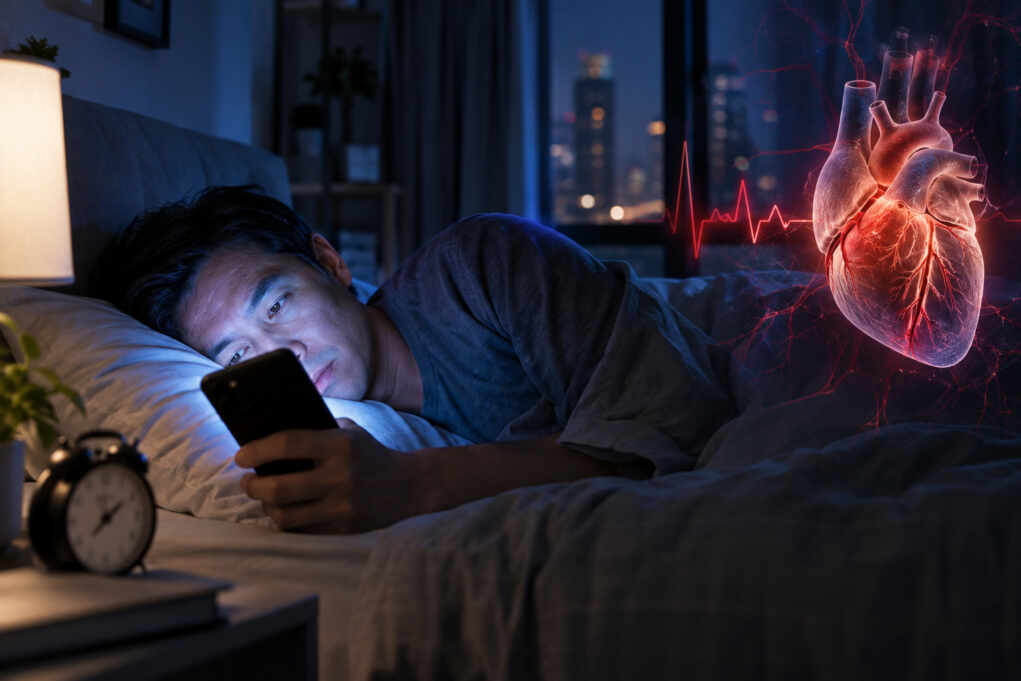
Artificial light has transformed modern life, allowing people to work, travel, communicate and stay entertained long after sunset. But researchers are increasingly examining whether this convenience comes with a hidden cost. Emerging evidence suggests that exposure to light during the nighttime hours—whether from smartphones, televisions, bedroom lamps, streetlights or other sources—may interfere with the body’s natural biological clock and could be associated with cardiovascular problems.
The concern is not simply about losing sleep. Nighttime light can affect the circadian rhythm, the internal 24-hour system that helps regulate sleep, hormones, metabolism and other bodily processes. Recent research has found associations between greater nighttime light exposure and conditions such as high blood pressure, abnormal blood-sugar regulation, stroke and cardiovascular disease. While scientists are still determining exactly how much nighttime light is harmful and whether light itself directly causes heart disease, the growing evidence gives people another reason to pay attention to their sleeping environment.
How Nighttime Light May Affect The Body
The human body is designed to respond differently to light and darkness. During daylight, light helps signal that it is time to be awake and active. As darkness arrives, the body normally begins preparing for sleep.
Artificial light can interfere with this transition. According to the National Heart, Lung, and Blood Institute (NHLBI), nighttime light exposure can disrupt the body’s circadian rhythm and may trigger metabolic and biochemical changes that affect glucose and cardiovascular regulation.
Light exposure can also make it more difficult to achieve restorative sleep. Cleveland Clinic notes that light in the bedroom can stimulate the brain and interfere with deeper stages of sleep, while Mayo Clinic recommends keeping the bedroom dark and limiting exposure to light-emitting screens before bedtime.
Over time, repeatedly disrupting sleep and the circadian rhythm may have consequences for cardiovascular health.
Research Connects Nighttime Light With Cardiovascular Risk
One of the more recent studies examined nearly 89,000 adults aged 41 and older who wore light sensors for a week. Researchers subsequently followed the participants for approximately 9.5 years. People exposed to higher levels of light during the nighttime hours had higher rates of several cardiovascular conditions, including coronary artery disease, stroke, atrial fibrillation, heart attack and heart failure. The associations remained after researchers accounted for several conventional cardiovascular and sleep-related risk factors.
These findings are important, but they do not establish that nighttime light directly causes heart disease. Observational research can identify relationships between two factors but cannot, by itself, prove that one caused the other.
Earlier research provides additional clues. An NHLBI-supported study of older adults found that people exposed to moderate amounts of light while sleeping were more likely to have obesity, high blood pressure and diabetes—conditions that can increase cardiovascular risk.
The Heart May Not Be The Only Concern
Nighttime light exposure may affect several systems involved in cardiovascular health. In a small study highlighted by the American Heart Association in 2025, higher levels of artificial light at night were associated with greater stress-related activity in the brain, inflammation of blood vessels and increased cardiovascular risk. However, the researchers’ findings were presented as a scientific meeting abstract and had not undergone peer review at the time of the AHA report, so they should be considered preliminary.
Other research has examined nighttime outdoor light and stroke. The American Heart Association reported on a large study involving more than 28,000 people in China in which higher exposure to artificial outdoor light at night was associated with a greater risk of cerebrovascular disease. Again, an association does not establish that nighttime light was the direct cause of the health outcomes.
Why Sleep And Circadian Rhythms Matter
One possible explanation is that nighttime light changes the timing and quality of sleep. The circadian system helps coordinate many functions throughout the body, and light is one of its most powerful environmental signals.
When light reaches the eyes at night, it can tell the brain that it is still daytime. This can make falling asleep more difficult and potentially alter normal hormonal and metabolic processes. Harvard Health notes that nighttime light may disrupt both sleep and the body’s circadian rhythm, which could help explain its relationship with cardiovascular risk.
Sleep itself is closely connected with heart health. Mayo Clinic reports that inadequate sleep is associated with higher risks of obesity, high blood pressure, heart attack and diabetes. It recommends maintaining a consistent sleep schedule and keeping the bedroom dark and quiet.
Screens Aren’t The Only Source Of Nighttime Light
When people think about nighttime light exposure, smartphones and tablets often come to mind first. But the source can be much broader.
Bedroom lamps, televisions, computer screens, illuminated clocks, hallway lighting and outdoor streetlights can all contribute to nighttime exposure. Even light entering through a window may matter, particularly when it is bright enough to interfere with sleep.
This does not mean that every small amount of light is dangerous. Researchers are still studying how brightness, duration, timing, color and individual sensitivity influence the effects of nighttime illumination.
What Can You Do To Reduce Nighttime Light?
Reducing unnecessary nighttime light is a relatively simple way to create a more sleep-friendly environment. Health organizations commonly recommend several practical measures:
- Keep the bedroom as dark as reasonably possible while sleeping.
- Turn off unnecessary lamps, televisions and other sources of illumination.
- Use curtains or shades to block bright outdoor light.
- Avoid prolonged exposure to bright screens immediately before bedtime.
- Keep phones and other illuminated devices away from the bed when practical.
- Use dim lighting during the period before sleep rather than bright overhead lighting.
- Maintain a consistent sleep and wake schedule.
These steps should not be viewed as a substitute for established measures such as controlling blood pressure, exercising regularly, avoiding tobacco and following appropriate medical advice. Instead, reducing nighttime light can be considered one part of a broader approach to healthy sleep and cardiovascular health.
The Evidence Is Growing, But Questions Remain
The relationship between nighttime light and heart disease is an active area of research. Studies increasingly point toward associations involving cardiovascular disease, blood pressure, metabolism, inflammation and disrupted circadian rhythms. At the same time, researchers continue to investigate whether nighttime light independently contributes to disease or partly reflects other factors, such as poor sleep, irregular schedules, environmental conditions or lifestyle habits.
For now, the evidence provides a reasonable rationale for protecting darkness during sleep. A dark bedroom may support better sleep, while better sleep is an established component of cardiovascular health. As researchers continue to study the biological effects of artificial light, reducing unnecessary illumination at night is a straightforward habit that can support a healthier sleep environment.
Sources:
- Harvard Health — Nighttime light exposure linked to heart disease
- American Heart Association — Exposure to more artificial light at night may raise heart disease risk
- National Heart, Lung, and Blood Institute (NIH) — Turn off all the lights at night: Your heart will thank you
- Cleveland Clinic — Is It Bad to Sleep With the Lights On?
- Mayo Clinic — Strategies to prevent heart disease
Website operated and published by:
FAB LTD
Ground Floor, 14 Stewart Dr.
Berea, East London 5241
South Africa
Disclaimer
The watching, interacting, and participation of any kind with anything on this page does not constitute or initiate a doctor-patient relationship with Dr. Farrah™. None of the statements here have been evaluated by the Food and Drug Administration (FDA). The products of Dr. Farrah™ are not intended to diagnose, treat, cure, or prevent any disease. The information being provided should only be considered for education and entertainment purposes only. If you feel that anything you see or hear may be of value to you on this page or on any other medium of any kind associated with, showing, or quoting anything relating to Dr. Farrah™ in any way at any time, you are encouraged to and agree to consult with a licensed healthcare professional in your area to discuss it. If you feel that you’re having a healthcare emergency, seek medical attention immediately. The views expressed here are simply either the views and opinions of Dr. Farrah™ or others appearing and are protected under the First Amendment.
Dr. Farrah™ is a highly experienced Licensed Medical Doctor certified in evidence-based clinical nutrition, not some enthusiast, formulator, or medium promoting the wild and unrestrained use of nutrition products for health issues without clinical experience and scientific evidence of therapeutic benefit. Dr. Farrah™ has personally and keenly studied everything she recommends, and more importantly, she’s closely observed the reactions and results in a clinical setting countless times over the course of her career involving the treatment of over 150,000 patients.
Dr. Farrah™ promotes evidence-based natural approaches to health, which means integrating her individual scientific and clinical expertise with the best available external clinical evidence from systematic research. By individual clinical expertise, I refer to the proficiency and judgment that individual clinicians acquire through clinical experience and clinical practice.
Dr. Farrah™ does not make any representations or warranties with respect to the accuracy, applicability, fitness, or completeness of any multimedia content provided. Dr. Farrah™ does not warrant the performance, effectiveness, or applicability of any sites listed, linked, or referenced to, in, or by any multimedia content.
To be clear, the multimedia content is not intended to be a substitute for professional medical advice, diagnosis, or treatment. Always seek the advice of your physician or other qualified health providers with any questions you may have regarding a medical condition. Never disregard professional medical advice or delay in seeking it because of something you have read or seen in any website, video, image, or media of any kind. Dr. Farrah™ hereby disclaims any and all liability to any party for any direct, indirect, implied, punitive, special, incidental, or other consequential damages arising directly or indirectly from any use of the content, which is provided as is, and without warranties.