
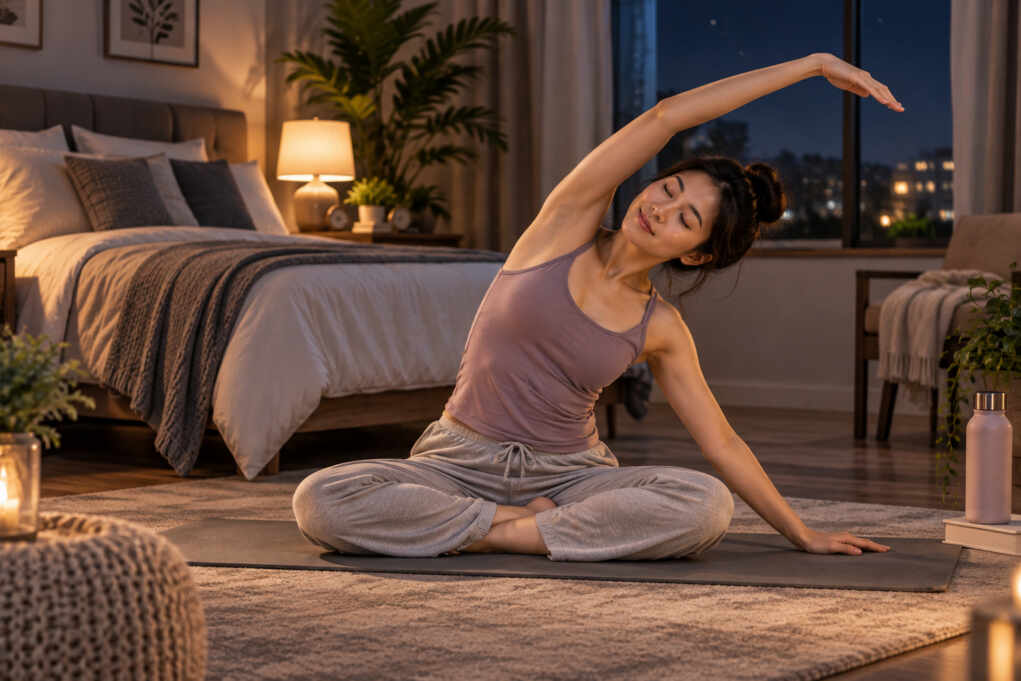
After a long day, your body can carry more tension than you realize. Hours spent sitting at a desk, standing, exercising, commuting, or looking down at a phone can leave your neck, shoulders, back, and legs feeling tight. Adding a few gentle stretches to your evening routine may help release some of that tension while giving your body a quiet signal that it is time to slow down.
Stretching before bed is not a cure for insomnia, but it can be a useful part of a relaxing nighttime routine. Gentle, slow movements can encourage relaxation, reduce feelings of physical tension, and help you shift your attention away from the stresses of the day. Health experts generally recommend keeping bedtime stretching comfortable and low intensity rather than turning it into a vigorous workout.
1. Neck Side Stretch
Neck tension is common after spending much of the day at a computer or looking at a phone. A gentle side stretch can help loosen the muscles around the neck and shoulders.
How to do it:
- Sit or stand comfortably with your back straight.
- Slowly bring your right ear toward your right shoulder.
- Keep your shoulders relaxed rather than lifting them.
- Hold for about 5 to 10 seconds while breathing slowly.
- Return to the starting position and repeat on the other side.
- Repeat two to four times per side.
The movement should feel gentle. Never pull forcefully on your head or neck.
2. Shoulder Stretch
Your shoulders can accumulate tension throughout the day, particularly if you spend hours sitting or working at a desk.
How to do it:
- Sit or stand with your arms relaxed.
- Slowly raise your shoulders toward your ears.
- Hold for about three seconds.
- Roll your shoulders backward and gently lower them.
- Repeat approximately 10 times.
Pair the movement with slow breathing to make it feel more like a relaxation exercise than a workout.
3. Child’s Pose
Child’s pose is a gentle yoga position that can stretch the back, shoulders, and hips while encouraging you to slow your breathing.
How to do it:
- Kneel comfortably on the floor.
- Sit your hips back toward your heels.
- Slowly fold your upper body forward.
- Rest your forehead on the floor or on a cushion.
- Extend your arms forward or place them alongside your body.
- Take several slow, comfortable breaths.
If your hips, knees, or back are uncomfortable, use cushions for additional support or choose another stretch.
4. Knee-to-Chest Stretch
This simple stretch can be particularly relaxing after a day spent sitting. It gently targets the lower back and hips.
How to do it:
- Lie on your back on a comfortable, firm surface.
- Bend one knee and gently bring it toward your chest.
- Hold the position for around 10 to 30 seconds.
- Slowly lower the leg.
- Repeat with the opposite leg.
Keep the movement slow and controlled rather than pulling aggressively on your knee. Mayo Clinic recommends stretching only until you feel a gentle pull rather than pain.
5. Seated Forward Stretch
A seated forward stretch can provide a gentle release for the back of the legs and lower back.
How to do it:
- Sit on the floor with your legs extended comfortably in front of you.
- Keep your spine long and shoulders relaxed.
- Slowly hinge forward from your hips.
- Reach toward your legs only as far as feels comfortable.
- Hold for about 20 to 30 seconds while breathing slowly.
- Return to an upright position.
There is no need to touch your toes. Flexibility varies from person to person, so focus on a comfortable stretch rather than how far you can reach.
6. Legs-Up-the-Wall Pose
If your legs feel tired after a busy day, this restorative position can be a calming way to finish your stretching routine.
How to do it:
- Sit beside a wall with one hip close to it.
- Lie back while gently swinging your legs upward.
- Rest your legs against the wall.
- Keep your arms in whatever position feels comfortable.
- Stay there for about one minute while taking slow breaths.
You can move your hips slightly away from the wall or place a cushion beneath them if that feels more comfortable.
7. Gentle Hamstring Stretch
Tight hamstrings can contribute to an overall feeling of stiffness, especially after sitting for extended periods.
How to do it:
- Sit on the floor or on the edge of a firm bed.
- Extend one leg while keeping the other comfortably bent.
- Keep your back relatively straight and lean forward slightly from your hips.
- Stop when you feel a gentle stretch behind your thigh.
- Hold for approximately 20 to 30 seconds.
- Switch sides.
Avoid bouncing or forcing the movement. Slow, steady stretching is more appropriate for a relaxing bedtime routine.
8. Reclining Bound Angle Pose
This gentle hip-opening position can be a relaxing final stretch, particularly if you spend much of your day sitting.
How to do it:
- Lie comfortably on your back.
- Bend your knees and bring the soles of your feet together.
- Allow your knees to gently move outward.
- Place pillows beneath your knees if they need additional support.
- Rest your arms comfortably at your sides.
- Stay in the position for 30 seconds to one minute while breathing slowly.
Never force your knees toward the floor. The goal is relaxation, not maximum flexibility.
How Long Should You Stretch Before Bed?
You do not need a long workout to benefit from a bedtime stretching routine. A few gentle stretches performed for several minutes may be enough to help you transition from a busy day to a calmer state.
The Sleep Foundation suggests incorporating relaxation practices such as gentle stretching into the period before bed, with slow, low-intensity movements generally being preferable at night. Mayo Clinic also recommends holding a typical stretch for around 30 seconds and avoiding bouncing.
A simple routine could look like this:
- Neck side stretch — 30 seconds per side
- Shoulder rolls — 10 repetitions
- Child’s pose — 30 to 60 seconds
- Knee-to-chest stretch — 30 seconds per side
- Legs-up-the-wall pose — 1 minute
- Slow breathing — 1 to 2 minutes
The entire routine can take only five to 10 minutes.
Tips for Making Bedtime Stretching More Relaxing
Stretching tends to work best as part of a broader wind-down routine rather than as a standalone solution for poor sleep. Cleveland Clinic recommends relaxation-focused habits such as gentle stretching or bedtime yoga, while other sleep guidance emphasizes maintaining a consistent bedtime routine and reducing stimulating activities before bed.
To make your routine more sleep-friendly:
- Keep the movements gentle. Bedtime is generally not the ideal time for an intense workout.
- Breathe slowly. Try to inhale comfortably and make your exhale slightly longer.
- Dim the lights. A darker, calmer environment can help signal that the day is ending.
- Reduce screen use. Put phones, tablets, and computers aside as you begin winding down.
- Be consistent. Performing the same relaxing activities each night can help establish a predictable bedtime routine.
- Listen to your body. A stretch should feel comfortable or mildly challenging, never painful.
Can Stretching Really Help You Sleep Better?
Research on stretching specifically as a treatment for sleep problems is still developing, so it is best viewed as one component of good sleep habits rather than a guaranteed remedy. However, gentle stretching may help by reducing physical tension and encouraging relaxation. Practices that combine gentle movement, breathing, and mindfulness may also help create a calmer transition into sleep.
If you regularly have difficulty falling asleep, wake frequently during the night, or remain tired despite getting enough time in bed, stretching alone may not address the underlying problem. Johns Hopkins Medicine notes that persistent sleep difficulties can be associated with conditions such as insomnia or sleep apnea and may warrant professional evaluation.
Final Thoughts
A few minutes of gentle stretching can be an easy way to end the day. Focus on slow movements, comfortable positions, relaxed breathing, and consistency rather than trying to achieve maximum flexibility. Neck stretches, child’s pose, knee-to-chest stretches, hamstring stretches, and legs-up-the-wall pose are all simple options to try.
Think of bedtime stretching as an invitation to slow down. Combined with a regular sleep schedule, a comfortable sleep environment, reduced evening stimulation, and other healthy sleep habits, it can become a simple ritual that helps prepare both your body and mind for rest.
Sources:
- Healthline — “Stretching Before Bed: 8 Stretches to Do at Night Before Sleep”
- Sleep Foundation — “Stretching Before Bed”
- Mayo Clinic — “A Guide to Basic Stretches”
- Cleveland Clinic — “Rest Easy: 8 Ways to Improve Your Sleep Hygiene”
- Johns Hopkins Medicine — “Seven Ways to Get a Healthier Night’s Sleep”
Website operated and published by:
FAB LTD
Ground Floor, 14 Stewart Dr.
Berea, East London 5241
South Africa
Disclaimer
The watching, interacting, and participation of any kind with anything on this page does not constitute or initiate a doctor-patient relationship with Dr. Farrah™. None of the statements here have been evaluated by the Food and Drug Administration (FDA). The products of Dr. Farrah™ are not intended to diagnose, treat, cure, or prevent any disease. The information being provided should only be considered for education and entertainment purposes only. If you feel that anything you see or hear may be of value to you on this page or on any other medium of any kind associated with, showing, or quoting anything relating to Dr. Farrah™ in any way at any time, you are encouraged to and agree to consult with a licensed healthcare professional in your area to discuss it. If you feel that you’re having a healthcare emergency, seek medical attention immediately. The views expressed here are simply either the views and opinions of Dr. Farrah™ or others appearing and are protected under the First Amendment.
Dr. Farrah™ is a highly experienced Licensed Medical Doctor certified in evidence-based clinical nutrition, not some enthusiast, formulator, or medium promoting the wild and unrestrained use of nutrition products for health issues without clinical experience and scientific evidence of therapeutic benefit. Dr. Farrah™ has personally and keenly studied everything she recommends, and more importantly, she’s closely observed the reactions and results in a clinical setting countless times over the course of her career involving the treatment of over 150,000 patients.
Dr. Farrah™ promotes evidence-based natural approaches to health, which means integrating her individual scientific and clinical expertise with the best available external clinical evidence from systematic research. By individual clinical expertise, I refer to the proficiency and judgment that individual clinicians acquire through clinical experience and clinical practice.
Dr. Farrah™ does not make any representations or warranties with respect to the accuracy, applicability, fitness, or completeness of any multimedia content provided. Dr. Farrah™ does not warrant the performance, effectiveness, or applicability of any sites listed, linked, or referenced to, in, or by any multimedia content.
To be clear, the multimedia content is not intended to be a substitute for professional medical advice, diagnosis, or treatment. Always seek the advice of your physician or other qualified health providers with any questions you may have regarding a medical condition. Never disregard professional medical advice or delay in seeking it because of something you have read or seen in any website, video, image, or media of any kind. Dr. Farrah™ hereby disclaims any and all liability to any party for any direct, indirect, implied, punitive, special, incidental, or other consequential damages arising directly or indirectly from any use of the content, which is provided as is, and without warranties.