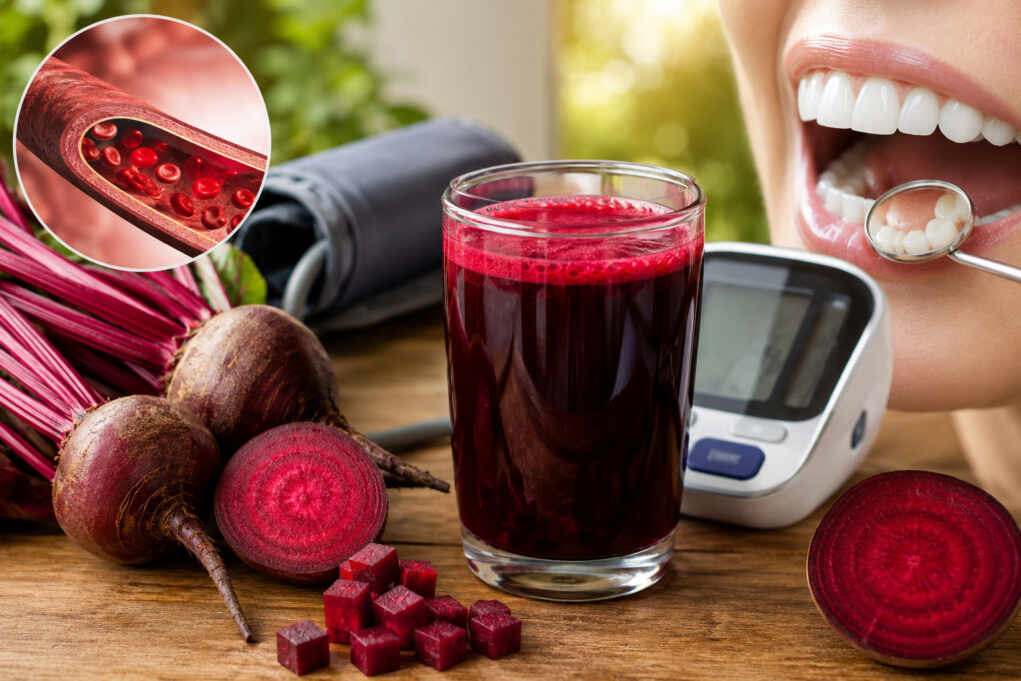
Beet juice has long attracted attention for its potential to support healthier blood pressure, but scientists are discovering that the secret to getting more from this ruby-red drink may have less to do with the juice itself—and more to do with what is living inside your mouth. Beets are naturally rich in dietary nitrates, which the body can convert into nitric oxide, a molecule that helps relax and widen blood vessels. That process can improve blood flow and, in some people, lower blood pressure.
Now, emerging research suggests that the mouth plays a surprisingly important role in this process. Certain oral bacteria help transform nitrate into nitrite, an important step before nitric oxide is produced. Studies published in 2025 found that the blood-pressure response to beetroot juice can be affected by the health and composition of the oral microbiome. In particular, researchers found that people with gum disease did not initially experience the same blood-pressure-lowering response to beet juice as people with healthy gums—but that response returned after periodontal treatment.
The Missing Piece May Be in Your Mouth
When you drink nitrate-rich beet juice, the nitrate does not simply travel through your digestive system and immediately become nitric oxide. A significant part of the process begins in the mouth.
Bacteria on the tongue and elsewhere in the oral cavity can convert dietary nitrate into nitrite. The nitrite can subsequently contribute to the production of nitric oxide, which helps blood vessels relax. This is one reason researchers have become increasingly interested in the oral microbiome when studying the cardiovascular effects of nitrate-rich foods.
Previous research has already demonstrated that disrupting nitrate-processing oral bacteria with antibacterial mouthwash can interfere with this pathway and produce a small rise in blood pressure.
That does not mean people should stop practicing good oral hygiene. Instead, the emerging message is more nuanced: maintaining a healthy oral environment may help the body make better use of dietary nitrates.
Gum Disease Could Blunt Beet Juice’s Effect
One of the most striking findings came from a 2025 study published in npj Biofilms and Microbiomes. Researchers compared people with healthy gums with people who had periodontitis, a serious form of gum disease.
The participants drank nitrate-rich beetroot juice, and researchers measured their blood pressure before and after consumption. Among people with healthy gums, systolic and diastolic blood pressure fell after drinking the juice. In participants with periodontitis, however, that immediate blood-pressure-lowering effect was not observed.
The researchers then followed the participants with periodontitis after they received periodontal treatment, including professional plaque removal, oral-hygiene instruction and treatment below the gumline. About 70 days later, the blood-pressure response to beetroot juice had returned.
After treatment, systolic blood pressure fell by about 4.4 mmHg on average after the beet juice, while diastolic pressure dropped by about 3.7 mmHg. The study was small—just 15 people with periodontitis and 15 healthy controls—so larger trials are needed before the findings can be considered definitive.
Still, the results provide an intriguing clue: the health of your gums could influence how effectively your body uses the nitrates in beet juice.
Researchers Are Also Seeing Changes in Oral Bacteria
Another 2025 study adds to the picture. Researchers investigating older adults with treated hypertension found that four weeks of nitrate-rich beetroot juice changed the composition of their oral microbiome. The researchers observed an increase in Neisseria bacteria and a decrease in Veillonella, suggesting that dietary nitrate may selectively influence bacteria in the mouth.
A separate University of Exeter study involving younger and older adults found that older participants experienced a meaningful reduction in blood pressure after drinking nitrate-rich beetroot juice twice daily for two weeks. The effect was associated with changes in their oral microbiome, including reductions in bacteria from the Prevotella group. Younger participants with normal blood pressure did not experience the same blood-pressure response.
The findings may help explain why beet juice does not affect everyone’s blood pressure in exactly the same way.
So, How Can You Get More From Beet Juice?
The research does not establish a guaranteed method for making beet juice dramatically more powerful. However, it points toward several sensible strategies.
Take care of your gums. Regular dental care and treatment of gum disease are important for overall health, and emerging evidence suggests that healthy gums may also support the nitrate-to-nitric-oxide pathway.
Be cautious about routinely using strong antibacterial mouthwash solely for cardiovascular reasons. Earlier controlled studies found that antibacterial mouthwash can reduce nitrate-to-nitrite conversion and slightly increase systolic blood pressure. However, mouthwash can be medically appropriate for some people, so it should not be discontinued without considering advice from a dentist or healthcare professional.
Remember that beet juice is not a substitute for blood-pressure treatment. Health experts generally regard beet juice as a possible dietary addition rather than a replacement for prescribed medication, physical activity, weight management, or a heart-healthy eating pattern. Cleveland Clinic notes that the effect of beets on blood pressure may be modest, while other health sources similarly recommend viewing beet juice as one part of an overall healthy diet.
Consider the whole beet, too. Beet juice provides concentrated nitrate, while whole beets supply additional fiber and nutrients. Both can be part of a balanced diet.
The Bigger Lesson: Food and the Microbiome Work Together
The most interesting part of this research may not be about beet juice at all. It highlights how closely nutrition, microbes and cardiovascular health can interact.
For years, scientists have focused primarily on what happens to food after it reaches the stomach and intestines. The nitrate story shows that digestion actually begins with an important microbial step in the mouth. The bacteria living there can influence how dietary compounds are processed and, potentially, how strongly those compounds affect the rest of the body.
That makes the oral microbiome an unexpected piece of the blood-pressure puzzle—and it could eventually lead researchers to investigate whether changing oral bacteria through diet, dental care or other approaches can improve cardiovascular health.
For now, the evidence is promising but still developing. Beet juice may provide a modest blood-pressure benefit, particularly for some people with elevated blood pressure, but the newest research suggests that getting the full benefit may depend partly on maintaining a healthy oral environment.
In other words, the next time you think about heart health, it may be worth thinking beyond what is on your plate—and paying attention to what’s happening in your mouth, too.
Sources:
- Healthline — Beet Juice: 11 Health Benefits, Blood Pressure, Cholesterol
- Cleveland Clinic — Can Certain Drinks Lower Your Blood Pressure?
- WebMD — The Truth About Beet Juice
- Verywell Health — Drinking Beet Juice for Just Two Weeks Can Help Lower Blood Pressure
- Health.com — What Happens to Your Blood Pressure When You Drink Beetroot Juice Every Day
Disclaimer
The watching, interacting, and participation of any kind with anything on this page does not constitute or initiate a doctor-patient relationship with Dr. Farrah™. None of the statements here have been evaluated by the Food and Drug Administration (FDA). The products of Dr. Farrah™ are not intended to diagnose, treat, cure, or prevent any disease. The information being provided should only be considered for education and entertainment purposes only. If you feel that anything you see or hear may be of value to you on this page or on any other medium of any kind associated with, showing, or quoting anything relating to Dr. Farrah™ in any way at any time, you are encouraged to and agree to consult with a licensed healthcare professional in your area to discuss it. If you feel that you’re having a healthcare emergency, seek medical attention immediately. The views expressed here are simply either the views and opinions of Dr. Farrah™ or others appearing and are protected under the First Amendment.
Dr. Farrah™ is a highly experienced Licensed Medical Doctor certified in evidence-based clinical nutrition, not some enthusiast, formulator, or medium promoting the wild and unrestrained use of nutrition products for health issues without clinical experience and scientific evidence of therapeutic benefit. Dr. Farrah™ has personally and keenly studied everything she recommends, and more importantly, she’s closely observed the reactions and results in a clinical setting countless times over the course of her career involving the treatment of over 150,000 patients.
Dr. Farrah™ promotes evidence-based natural approaches to health, which means integrating her individual scientific and clinical expertise with the best available external clinical evidence from systematic research. By individual clinical expertise, I refer to the proficiency and judgment that individual clinicians acquire through clinical experience and clinical practice.
Dr. Farrah™ does not make any representations or warranties with respect to the accuracy, applicability, fitness, or completeness of any multimedia content provided. Dr. Farrah™ does not warrant the performance, effectiveness, or applicability of any sites listed, linked, or referenced to, in, or by any multimedia content.
To be clear, the multimedia content is not intended to be a substitute for professional medical advice, diagnosis, or treatment. Always seek the advice of your physician or other qualified health providers with any questions you may have regarding a medical condition. Never disregard professional medical advice or delay in seeking it because of something you have read or seen in any website, video, image, or media of any kind. Dr. Farrah™ hereby disclaims any and all liability to any party for any direct, indirect, implied, punitive, special, incidental, or other consequential damages arising directly or indirectly from any use of the content, which is provided as is, and without warranties.